


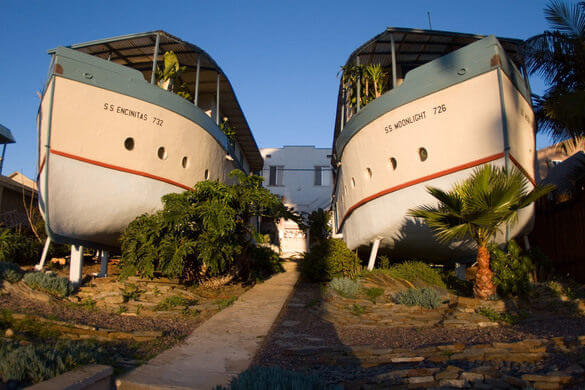
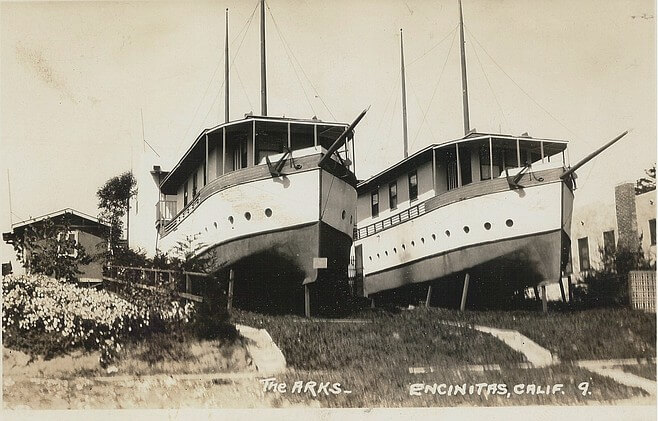
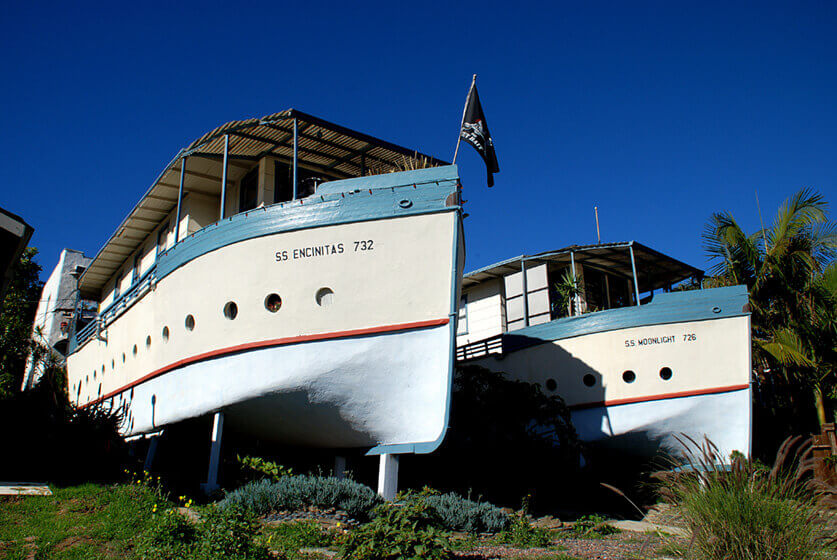
One of Encinitas’ most prized historic landmarks are the Encinitas boathouses, the S.S. Encinitas and the S.S. Moonlight. Built by architect Miles Kellogg in 1927-28, the boathouses were constructed from salvaged lumber sourced from the old Moonlight Beach bathhouse and a hotel that failed to survive the Prohibition’s dry years.
The boathouses are a rare example of "programmatic", “novelty” or "roadside" architecture which flourished in the early-to-mid 20th century with the expansion of car culture. Each house is 15 feet tall by 20 feet long and have a breathtaking stature when face to face with them. They are on the National Registry of Historic Places and they are quite possibly one of the most photographed attractions in Encinitas.
In order to protect this downtown gem, a partnership was forged with the Encinitas 101 MainStreet Association and the Encinitas Historical Society to purchase the boathouses in 2008 with a $1.55 million loan. The entire purchase included the boathouses, along with a four-unit apartment complex on the property. The additional four-unit complex is part of the City of Encinitas’ low-income housing program.
With the help of donations, rent and community partners, the EPA works hard to maintain this local treasure. Your help would ensure the protection of the boathouses for generations to come, please make a donation today.
Encinitas California sits on the coastline of the Pacific Ocean. To the north of Encinitas, there is Batiquitos Lagoon and the San Elijo Lagoon to the south. The first people living in the area of modern Encinitas, CA were Native Americans tribes, the San Dieguitos, the La Jollans, and the Dieguenos. Diegueno’s group were mission converts who wanted to build the Spanish Missions. In the year 1669, the Governor of Baja California, Gaspar de Portola, was traveling throughout the San Diego and Monterey in California area. His plan was to build so-called presidios, where the population could learn and attend religious service. De Portola and his expedition were traversing across our land and he named this area Encina Canada, Spanish for “Hills of live oak”, later shortened to Encinitas.
Encinitas was governed by Mexico after the year 1800, and the Mexican government issued land grants to ranchers who would be willing to be under Mexico’s rule.
In 1881, Jabez Pitcher came to Encinitas and many people consider him to be the father of the town. Pitcher came to San Diego and filed a claim for 160 acres on a mesa near the railroad tracks where the today Encinitas Civic Center is now located. In the year 1870, north of the railroad tracks, English spiritualists named their settlement Leucadia. The name means “Isle of Paradise” or “Place of Shelter” and is based upon Greek Island The five-acre tracts were named after Greek gods and myths.
The modern history of “Cardiff” started in the year 1875 when the McKinnon family populated the north shore of the San Elijo Lagoon. In the year 1909, J. Frank Cullen bought a big part in San Elijo, had it surveyed, and established streets and lots. He named his town in 1914, and called it “Cardiff-by-the-Sea,” after Cardiff, Wales, the part of United Kingdom. The “Olivenhain” portion of Encinitas was established as a community in 1884 by a small group of immigrants that came from Germany. The old Olivenhain Meeting Hall is still used today for social events and meetings.
The City of Encinitas California was founded around 100 years ago and today consists of five communities that take pride in their own distinct personalities. “Historic Encinitas” occupies the Highway 101 Corridor that parallels the beautiful beaches and ocean. “New Encinitas” centers on El Camino Real. “Cardiff-by-the-Sea” is made up of quaint homes dotting the hillsides overlooking the sea. “Leucadia” is famous for its giant eucalyptus trees that line the main thoroughfare on the Coast Highway. “Olivenhain” (which means “olive grove” in German) boasts plenty of open horse country, pastures, and a rural way of life.
Boathouses are located at
726 Third Street
Encinitas, California
(Note: this is not a mailing address)
Please do not disturb the residents. We invite you to view and take pictures from the sidewalk!